
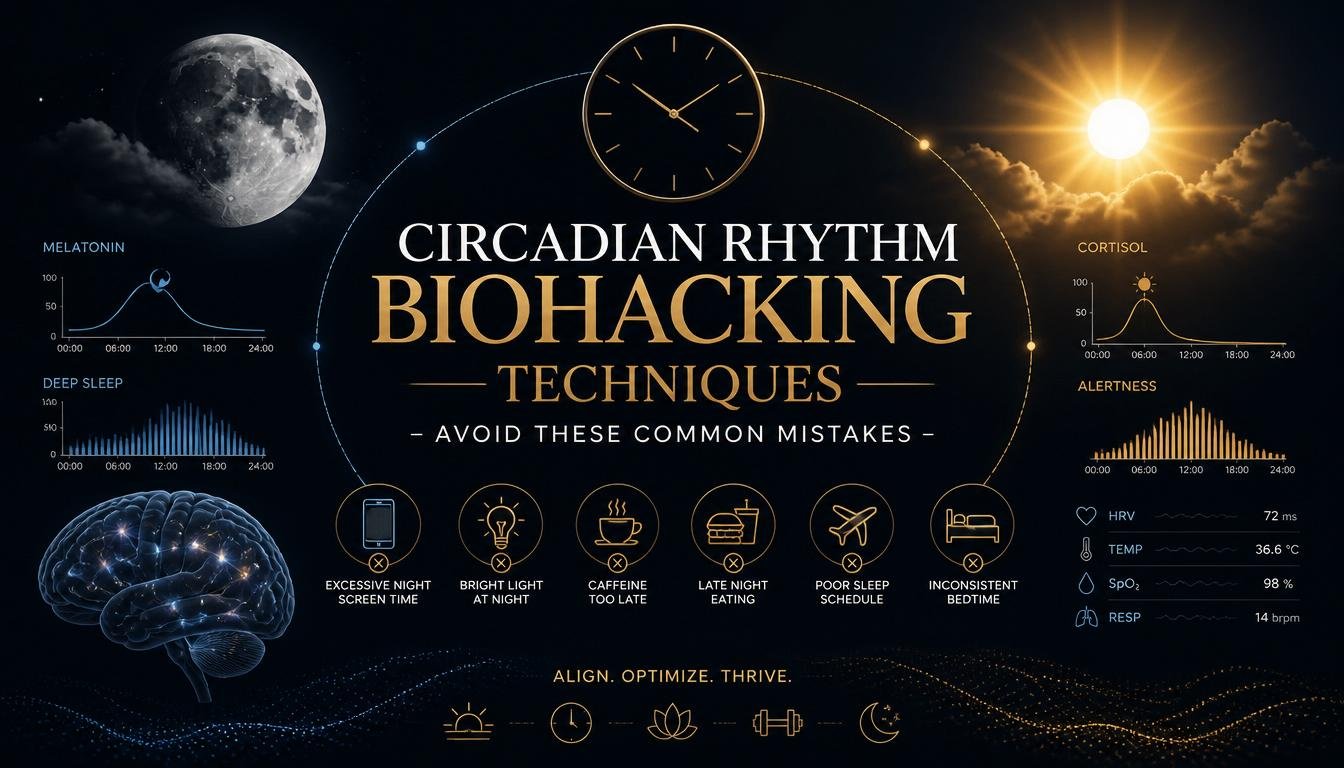

Circadian Rhythm Biohacking Techniques | Avoid These Common Mistakes
I once bought a pair of dark orange, industrial-strength blue blocking glasses that were so thick they made me look like a futuristic cyberpunk welder. I wore them to a family dinner at seven in the evening, refusing to take them off because I was terrified a single stray photon from my aunt’s kitchen light would ruin my sleep score. I ended up pouring gravy directly onto the tablecloth, tripping over a cat, and looking like an absolute lunatic. All in the name of biohacking.
The Master Clock: Meet Your Brain’s Internal Timer:
To understand why circadian rhythm optimization matters, you have to look inside your skull. Tucked deep inside your brain is a tiny control station called the suprachiasmatic nucleus. That is a massive medical name, so let us just call it the master clock.
This master clock acts like a conductor leading a massive orchestra. Every single organ in your body, from your heart to your liver, has its own tiny clock. When the master clock is working perfectly, your body releases a hormone called cortisol in the morning to make you feel sharp and energized. At night, it switches gears and pumps out melatonin to help you fall into a deep, restorative sleep.
The problem is that our modern world is filled with fake cues. Artificial lights, late-night snacks, and irregular schedules confuse the master clock. When your internal systems fall out of alignment, you experience a sort of permanent, everyday jet lag. You wake up feeling like a zombie, and you lie awake at midnight with a racing mind.
Mistake 1: Staring at the Morning Sun Through a Glass Window:
When I first learned that morning sunlight is the ultimate way to trigger the master clock, I used to sit comfortably on my living room couch and stare out the window for twenty minutes. I thought I was doing great. But I was still dragging my feet until noon.
Here is the technical reality that I missed: window glass blocks the exact wavelengths of blue sky light that your eyes need to kickstart your morning cortisol awakening response. Standard window glass filters out a massive amount of the light energy, which is measured in units called lux. On a bright morning, the outdoor light can easily measure over ten thousand lux, but sitting right behind a pane of window glass drops that number down to a weak fraction of its power.
The Correct Technique:
You must physically step outside within the first hour of waking up. Do not look directly at the sun, as that will damage your eyes. Just look toward the morning sky for ten to fifteen minutes without wearing sunglasses. Even on a cloudy, gray winter day, the ambient light outdoors is significantly stronger than the brightest light bulb inside your house. This simple, free habit dumps a wave of natural energy into your nervous system and sets a countdown timer for your body to release melatonin exactly fourteen hours later.
Mistake 2: Becoming a Blue-Light Phobic Vampire:
After my gravy-pouring disaster, I realized that many biohackers view blue light as a toxic poison that must be destroyed at all costs. They wear computer glasses all day long and live in dim rooms. This is a massive mistake that completely backfires.
Your body actually needs a massive amount of blue light during the bright daylight hours. Blue wavelengths from the sun tell your brain that it is daytime, which keeps your mood elevated and your focus sharp. If you filter out blue light all day long, your master clock never receives a clear signal that the day has started. This makes the boundary between day and night look blurry to your brain.
The Correct Technique:
Embrace bright light during the day. Open all your blinds, work near a window, or use a high-powered light therapy lamp at your desk during the morning hours. You only need to start shielding your eyes from artificial blue light after the sun goes down. Two hours before bedtime, switch off heavy overhead lights and rely on low-level lamps with warm, amber bulbs to mimic the natural glow of a setting sun.
Mistake 3: The Late-Night Kitchen Raid Trap:
I used to think that as long as I hit my daily calorie goals, it did not matter when I ate my food. I would regularly cook a massive, heavy bowl of spicy pasta at nine in the evening while watching television. I fell asleep easily enough, but I always woke up feeling bloated, stiff, and utterly exhausted.
This happens because your liver, your stomach, and your gut microbiome have their own independent peripheral clocks. These digestive timekeepers take their cues from food, not from the sun. When you dump a heavy meal into your stomach late at night, your gut clock yells, “Wake up, it is breakfast time!” while your brain clock is trying to say, “Quiet down, it is midnight!”
This severe internal misalignment wrecks your sleep architecture. Your body forces its energy toward heavy digestion instead of executing vital cellular repair and immune system maintenance routines.
The Correct Technique:
Establish a strict rule for your kitchen: lock the pantry doors at least three hours before your planned bedtime. If you plan to sleep at ten, finish your final bite of food by seven. This gives your digestive tract plenty of time to process the nutrients, allowing your core body temperature to drop naturally during the night, which is a vital prerequisite for reaching deep REM sleep cycles.
Mistake 4: Megadosing Synthetic Melatonin Supplements:
Walk into any local grocery store or pharmacy, and you will see bottles of melatonin supplements containing massive doses like five, ten, or even fifteen milligrams per capsule. For years, the moment I felt a little bit restless, I would pop a ten-milligram gummy and pass out cold.
This is a reckless way to handle your hormones. In a natural, healthy state, your pineal gland only secretes a tiny, microscopic fraction of a milligram of melatonin into your bloodstream. When you flood your brain with a massive ten-milligram synthetic hammer, you completely overwhelm your internal receptors.
Over time, your body can become desensitized to the hormone. Even worse, waking up with a mountain of leftover artificial melatonin in your system causes a heavy, miserable morning hangover that leaves you craving caffeine just to clear the brain fog.
The Correct Technique:
Treat melatonin as a temporary tool for shifting time zones during jet lag, not as a daily sleeping pill. If you do choose to use it, look for microdose versions that offer less than one milligram of total volume. The ultimate goal is to force your body to manufacture its own natural melatonin by practicing clean light hygiene instead of relying on a bottle.
Mistake 5: High-Tech Tracking Stress and Data Obsession:
With the massive explosion of modern health wearables, smart rings, and sleep tracking mattress pads, it is easy to become completely obsessed with your data. I used to wake up, look at my fitness tracker app, and feel my stomach drop if my sleep score was below eighty percent. I would spend the rest of the day worrying about my numbers, which ironically made me feel even more stressed.
This condition is so common that health professionals have a specific name for it: orthosomnia, which means a stressful obsession with achieving perfect sleep tracking data.
We are currently seeing a major shift away from this rigid, hyper-tracked biohacking style toward a philosophy called bioharmony. Bioharmony is all about listening to your internal body cues and moving with natural rhythms rather than treating your life like a giant, stressful math spreadsheet.
The Correct Technique:
Use your wearable technology as a general compass, not an absolute judge of your human value. If your sleep tracker says you had a poor night, but you actually open your eyes feeling relatively refreshed, trust your living body over the plastic sensor on your wrist. Turn off real-time score notifications if they cause you mental panic, and focus on how your energy levels feel throughout the day.
Conclusion:
True circadian rhythm biohacking is not about purchasing expensive gadgets, isolating yourself from society, or forcing your daily routine into a rigid set of stressful metrics. It is simply about restoring the natural, evolutionary connection between your body and the planet. By stepping outside into the raw morning daylight, embracing bright afternoons, keeping your late nights dim and free of heavy meals, and resting from data perfectionism, you allow your internal master clock to find its perfect harmony. Listen to your body, respect the natural patterns of day and night, and you will unlock a sustainable pool of daily focus and deep, restorative sleep.
FAQs:
1. Can blue-blocking glasses completely cure my chronic insomnia?
No, blue-blocking glasses are just a minor tool and cannot fix poor sleep if you have bad daytime habits or high stress levels.
2. How long does it take to completely reset a broken circadian rhythm?
Most people can successfully recalibrate their internal master clock within one to three weeks of consistent light and meal timing habits.
3. Does working under bright fluorescent office lights count as morning sun exposure?
No, artificial indoor lights lack the high lux power and specific wavelengths required to effectively reset your brain’s morning clock.
4. Is it harmful to exercise intensely right before going to bed?
Yes, late-night workouts raise your core body temperature and spike stress hormones, which delay your natural transition into deep sleep.
5. Can a weekend sleep-in session fix a week of bad sleep habits?
No, sleeping in late on weekends actually creates a pattern called social jet lag, which further confuses your internal master clock.
6. Why do I feel incredibly hungry when my sleep schedule is completely messed up?
A disrupted circadian rhythm throws off your appetite hormones, causing your brain to crave quick energy from heavy carbohydrates and sugars.