
Clinical Burnout | Beyond the Self-Care Myth

I once attended a mandatory hospital seminar on “Burnout Prevention” where they handed out lukewarm herbal tea and a pamphlet on “Mindful Breathing” while my pager was screaming like a banshee in my pocket. I was three hours late for dinner, I hadn’t seen my own family in daylight for four days, and I was being told that the solution to my soul-crushing exhaustion was a scented candle and a “positive attitude.” It was like trying to put out a forest fire with a water pistol filled with lavender essential oil. I realized then that the “Self-Care Myth” isn’t just annoying; it’s a form of gaslighting. It tells the clinician that the problem is their “resilience,” rather than a system that is fundamentally designed to consume human beings like fuel.

1. The Day I Realized “Yoga” Wasn’t Enough:

For months, I tried to “self-care” my way out of clinical burnout. I woke up at 5:00 AM to meditate, I drank enough green smoothies to turn my skin a faint shade of kale, and I practiced deep breathing until I was practically hyperventilating. I was the “Gold Standard” of self-care.

Yet, when I pulled into the hospital parking lot, my hands would shake. I would sit in my car for ten minutes, staring at the concrete, feeling a sense of dread so heavy it felt physical.

The problem wasn’t my personal habits. The problem was that I was returning every day to an environment of Moral Injury. I was being asked to care for forty patients when I only had the time to truly see ten. I was spending 60% of my day fighting with insurance companies and clunky EHR (Electronic Health Record) software rather than actually practicing medicine. Burnout isn’t a “lack of relaxation”; it is the erosion of the soul caused by a disconnect between your values and your daily reality. No amount of downward dog can fix a broken infrastructure.

2. Burnout vs. Moral Injury: Shifting the Language:

We need to stop calling it “Burnout” and start calling it what it often is: Moral Injury.

The term “Burnout” implies that I am a battery that just ran out of juice. If I “recharge” on vacation, I should be fine, right? But “Moral Injury” is different. It’s the psychological distress that results from actions, or the lack of them, that violate your moral or ethical code.

In my practice, the “injury” came from the systemic constraints that prevented me from giving my patients the care they deserved.

  • It was knowing a patient needed a specific treatment but being forced to deny it because of “Protocol.”
  • It was having to rush through a terminal diagnosis conversation because I was “behind schedule.”
  • It was the “Death by a Thousand Clicks” that turned my patients into data points.

When I shifted my language from “I’m burned out” to “I am morally injured by this system,” the shame vanished. I wasn’t “weak.” I was a person with a conscience reacting to a dysfunctional environment. This distinction is the first step toward actual healing.

3. The “Efficiency” Trap: Why We Can’t Breathe:

The modern clinical environment is obsessed with Throughput. We are treated like assembly-line workers in a factory of “Wellness.”

I remember a specific administrator telling me that if I could shave just 90 seconds off every patient encounter, I could see two more patients a day. In the world of spreadsheets, that’s “Efficiency.” In the world of clinical care, that’s the death of the relationship.

Those 90 seconds are where the “Medicine” happens. It’s the moment the patient finally feels safe enough to tell you about the lump they found, or the grief that’s keeping them awake. When we optimize for speed, we dehumanize the process. I started prioritizing my own sanity by refusing the “Efficiency” metric. I realized that if I worked at the pace the system demanded, I would eventually stop caring altogether. And a clinician who doesn’t care is the most dangerous person in the room.

4. The Myth of the “Resilient” Clinician:

There is a dangerous trope in our industry: The “Super-Doc” or the “Angel Nurse” who can handle anything without breaking. We are taught that “Resilience” means being an indestructible brick wall.

I’ve learned that true resilience isn’t about being unbreakable; it’s about being Flexible and Honest. The “Strong” people I knew were the ones who crashed the hardest because they never allowed themselves to say, “I am overwhelmed.” They viewed a need for help as a professional failure.

I started fighting the “Self-Care Myth” by being radically honest with my colleagues. I started saying, “This shift was brutal, and I’m not okay.” When we stop pretending to be superhuman, we create space for actual support. Resilience shouldn’t be a “Solo Sport.” It should be a “Team Effort” where we look out for each other’s humanity, not just each other’s “Productivity.”

5. Systemic Solutions: What “Real” Care Looks Like:

If scented candles aren’t the answer, what is? After my own burnout-induced “Great Awakening,” I started advocating for Systemic Interventions.

Real care for clinicians looks like:

  • Scribe Support: Removing the 4 hours of data entry that follow an 8-hour shift.
  • Protected Time: Ensuring that “Administrative Tasks” have their own block of time that isn’t stolen from lunch or sleep.
  • Meaningful Autonomy: Giving providers the power to make clinical decisions without a bureaucratic “Permission Slip.”
  • Rational Staffing: Moving away from “Lean” staffing models that leave no room for human error or fatigue.

I stopped asking for “Wellness Rooms” and started asking for “Process Improvements.” I realized that a well-designed workflow is more “Healing” than any meditation app. If you want to help a drowning person, don’t give them a breathing exercise, pull them out of the water.

6. The “Second Victim” Phenomenon:

One of the deepest roots of clinical burnout is the Fear of Error. In our culture, a medical error is treated as a personal moral failure rather than a systemic glitch.

When something goes wrong, the clinician becomes the “Second Victim.” We carry the guilt, the shame, and the “What-Ifs” for years. In my case, a minor medication error (that thankfully didn’t harm the patient) haunted me for months. I didn’t need “Self-Care”; I needed a Just Culture.

A “Just Culture” recognizes that humans make mistakes and looks at the system that allowed the mistake to happen. When I worked in an environment that prioritized “Learning” over “Blaming,” my burnout levels plummeted. The constant, low-level anxiety of being “Perfect” is a weight no human can carry indefinitely.

7. Reclaiming the “Why”: The Only Real Antidote:

The only thing that ever truly “recharged” me wasn’t a day at the spa; it was a meaningful connection with a patient.

Burnout happens when the “Drudgery” (paperwork, politics, billing) outweighs the “Meaning” (healing, connection, service). I started a practice I call “Meaning Mining.” Every day, I force myself to find one moment where I actually made a difference. I write it down.

When the pile of “Meaningless” tasks gets too high, I look at that list. It reminds me that I am not a “Data Entry Clerk with a Stethoscope.” I am a healer. However, the system makes this “Meaning” harder and harder to find. If you have to dig through six feet of bureaucratic sludge to find one moment of joy, you will eventually stop digging. That’s why we must fight for the “Right to Care.”

8. The Boundaries of the “Vocation.”:

We are told that medicine is a “Calling,” and therefore, we should be willing to sacrifice everything for it. This is a trap.

A “Calling” shouldn’t be a “Suicide Pact.” I had to learn the hard way to set Rigid Boundaries.

  • I stopped checking emails at home.
  • I stopped saying “Yes” to every extra committee or weekend shift.
  • I started treating my time with my family as a “Non-Negotiable Medical Appointment.”

When I treated my work as a “Highly Skilled Profession” rather than an “All-Consuming Identity,” the burnout began to lift. I became a better clinician because I was a more “Complete” human being. You cannot pour from an empty cup, no matter how “Called” you feel to do so.

The Bottom Line:

I’m done with the herbal tea and the “Mindfulness” posters. Clinical burnout isn’t a “Personal Problem” that can be fixed with a better morning routine; it is a “Systemic Crisis” that requires a total re-evaluation of how we value human labor in healthcare. We don’t need more “Resilience Training”; we need a system that doesn’t try to break us in the first place. If you are feeling the “Burn,” know that it isn’t because you aren’t “strong enough.” It’s because you are a human being in a machine that has forgotten what humanity looks like. It’s time to stop fixing the “Self” and start fixing the “System.”

FAQs:

1. Is burnout just “Stress”?

No. Stress is about “Too Much”—too many tasks, too much pressure. Burnout is about “Not Enough”—not enough meaning, not enough hope, not enough care.

2. Why does the system push “Self-Care” so hard?

Because it’s cheaper and easier to tell you to “Meditate” than it is to hire more staff or fix the software. It shifts the burden of the problem from the Organization to the Individual.

3. Can I recover from burnout without quitting my job?

Sometimes, but it requires “Radical Systemic Changes” in how you work and a willingness to set boundaries that might make you “Less Productive” in the eyes of the system.

4. What is the first step toward recovery?

Acknowledge that you aren’t the problem. Stop blaming your “Lack of Resilience” and start looking at the “Moral Injury” of your environment.

5. How can leadership help?

By listening to the frontline staff and removing the “Friction” in their day. Ask: “What is the most annoying thing you have to do today?”—then fix that.

6. Does everyone in healthcare get burned out?

Recent data suggests up to 50-60% of clinicians experience symptoms. It is an epidemic, not an individual failing.
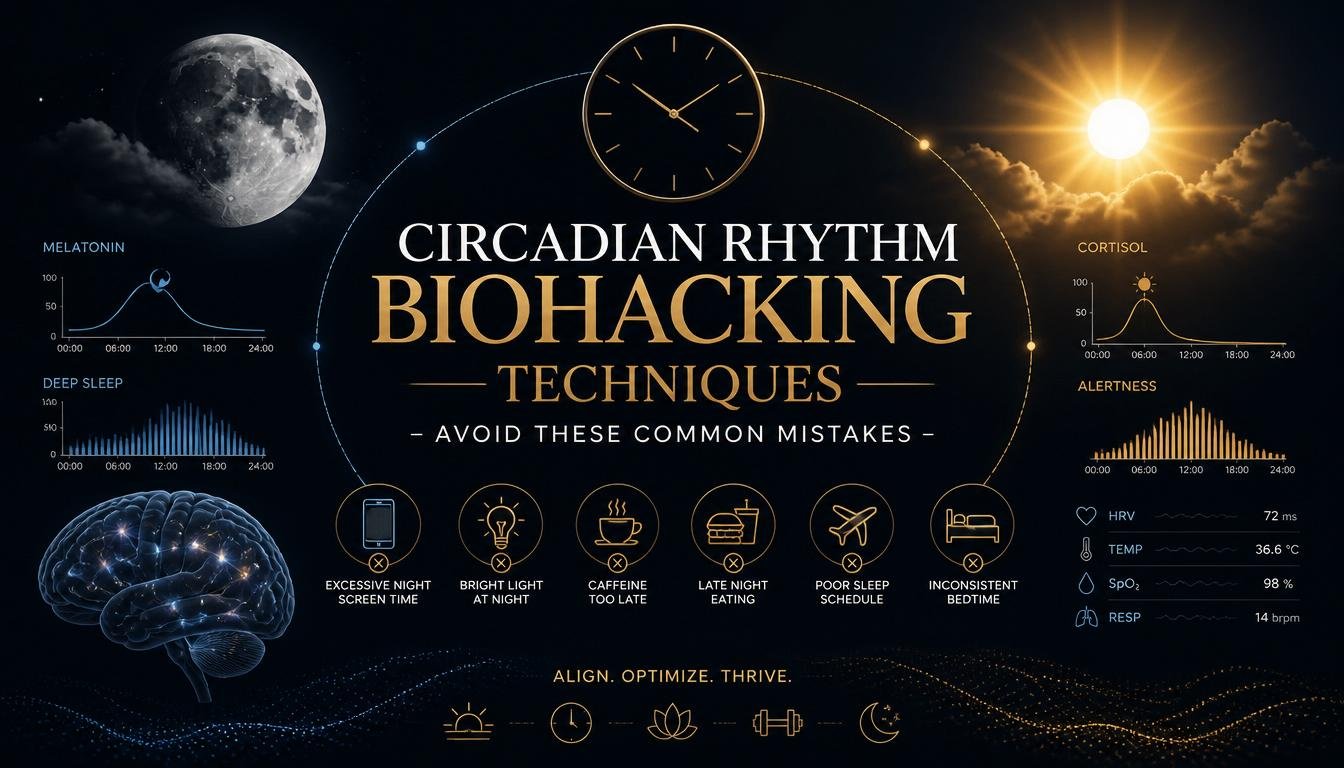
Circadian Rhythm Biohacking Techniques | Avoid These Common Mistakes

I once bought a pair of dark orange, industrial-strength blue blocking glasses that were so thick they made me look like a futuristic cyberpunk welder. I wore them to a family dinner at seven in the evening, refusing to take them off because I was terrified a single stray photon from my aunt’s kitchen light would ruin my sleep score. I ended up pouring gravy directly onto the tablecloth, tripping over a cat, and looking like an absolute lunatic. All in the name of biohacking.

The Master Clock: Meet Your Brain’s Internal Timer:

To understand why circadian rhythm optimization matters, you have to look inside your skull. Tucked deep inside your brain is a tiny control station called the suprachiasmatic nucleus. That is a massive medical name, so let us just call it the master clock.

This master clock acts like a conductor leading a massive orchestra. Every single organ in your body, from your heart to your liver, has its own tiny clock. When the master clock is working perfectly, your body releases a hormone called cortisol in the morning to make you feel sharp and energized. At night, it switches gears and pumps out melatonin to help you fall into a deep, restorative sleep.

The problem is that our modern world is filled with fake cues. Artificial lights, late-night snacks, and irregular schedules confuse the master clock. When your internal systems fall out of alignment, you experience a sort of permanent, everyday jet lag. You wake up feeling like a zombie, and you lie awake at midnight with a racing mind.

Mistake 1: Staring at the Morning Sun Through a Glass Window:

When I first learned that morning sunlight is the ultimate way to trigger the master clock, I used to sit comfortably on my living room couch and stare out the window for twenty minutes. I thought I was doing great. But I was still dragging my feet until noon.

Here is the technical reality that I missed: window glass blocks the exact wavelengths of blue sky light that your eyes need to kickstart your morning cortisol awakening response. Standard window glass filters out a massive amount of the light energy, which is measured in units called lux. On a bright morning, the outdoor light can easily measure over ten thousand lux, but sitting right behind a pane of window glass drops that number down to a weak fraction of its power.

The Correct Technique:

You must physically step outside within the first hour of waking up. Do not look directly at the sun, as that will damage your eyes. Just look toward the morning sky for ten to fifteen minutes without wearing sunglasses. Even on a cloudy, gray winter day, the ambient light outdoors is significantly stronger than the brightest light bulb inside your house. This simple, free habit dumps a wave of natural energy into your nervous system and sets a countdown timer for your body to release melatonin exactly fourteen hours later.

Mistake 2: Becoming a Blue-Light Phobic Vampire:

After my gravy-pouring disaster, I realized that many biohackers view blue light as a toxic poison that must be destroyed at all costs. They wear computer glasses all day long and live in dim rooms. This is a massive mistake that completely backfires.

Your body actually needs a massive amount of blue light during the bright daylight hours. Blue wavelengths from the sun tell your brain that it is daytime, which keeps your mood elevated and your focus sharp. If you filter out blue light all day long, your master clock never receives a clear signal that the day has started. This makes the boundary between day and night look blurry to your brain.

The Correct Technique:

Embrace bright light during the day. Open all your blinds, work near a window, or use a high-powered light therapy lamp at your desk during the morning hours. You only need to start shielding your eyes from artificial blue light after the sun goes down. Two hours before bedtime, switch off heavy overhead lights and rely on low-level lamps with warm, amber bulbs to mimic the natural glow of a setting sun.

Mistake 3: The Late-Night Kitchen Raid Trap:

I used to think that as long as I hit my daily calorie goals, it did not matter when I ate my food. I would regularly cook a massive, heavy bowl of spicy pasta at nine in the evening while watching television. I fell asleep easily enough, but I always woke up feeling bloated, stiff, and utterly exhausted.

This happens because your liver, your stomach, and your gut microbiome have their own independent peripheral clocks. These digestive timekeepers take their cues from food, not from the sun. When you dump a heavy meal into your stomach late at night, your gut clock yells, “Wake up, it is breakfast time!” while your brain clock is trying to say, “Quiet down, it is midnight!”

This severe internal misalignment wrecks your sleep architecture. Your body forces its energy toward heavy digestion instead of executing vital cellular repair and immune system maintenance routines.

The Correct Technique:

Establish a strict rule for your kitchen: lock the pantry doors at least three hours before your planned bedtime. If you plan to sleep at ten, finish your final bite of food by seven. This gives your digestive tract plenty of time to process the nutrients, allowing your core body temperature to drop naturally during the night, which is a vital prerequisite for reaching deep REM sleep cycles.

Mistake 4: Megadosing Synthetic Melatonin Supplements:

Walk into any local grocery store or pharmacy, and you will see bottles of melatonin supplements containing massive doses like five, ten, or even fifteen milligrams per capsule. For years, the moment I felt a little bit restless, I would pop a ten-milligram gummy and pass out cold.

This is a reckless way to handle your hormones. In a natural, healthy state, your pineal gland only secretes a tiny, microscopic fraction of a milligram of melatonin into your bloodstream. When you flood your brain with a massive ten-milligram synthetic hammer, you completely overwhelm your internal receptors.

Over time, your body can become desensitized to the hormone. Even worse, waking up with a mountain of leftover artificial melatonin in your system causes a heavy, miserable morning hangover that leaves you craving caffeine just to clear the brain fog.

The Correct Technique:

Treat melatonin as a temporary tool for shifting time zones during jet lag, not as a daily sleeping pill. If you do choose to use it, look for microdose versions that offer less than one milligram of total volume. The ultimate goal is to force your body to manufacture its own natural melatonin by practicing clean light hygiene instead of relying on a bottle.

Mistake 5: High-Tech Tracking Stress and Data Obsession:

With the massive explosion of modern health wearables, smart rings, and sleep tracking mattress pads, it is easy to become completely obsessed with your data. I used to wake up, look at my fitness tracker app, and feel my stomach drop if my sleep score was below eighty percent. I would spend the rest of the day worrying about my numbers, which ironically made me feel even more stressed.

This condition is so common that health professionals have a specific name for it: orthosomnia, which means a stressful obsession with achieving perfect sleep tracking data.

We are currently seeing a major shift away from this rigid, hyper-tracked biohacking style toward a philosophy called bioharmony. Bioharmony is all about listening to your internal body cues and moving with natural rhythms rather than treating your life like a giant, stressful math spreadsheet.

The Correct Technique:

Use your wearable technology as a general compass, not an absolute judge of your human value. If your sleep tracker says you had a poor night, but you actually open your eyes feeling relatively refreshed, trust your living body over the plastic sensor on your wrist. Turn off real-time score notifications if they cause you mental panic, and focus on how your energy levels feel throughout the day.

Conclusion:

True circadian rhythm biohacking is not about purchasing expensive gadgets, isolating yourself from society, or forcing your daily routine into a rigid set of stressful metrics. It is simply about restoring the natural, evolutionary connection between your body and the planet. By stepping outside into the raw morning daylight, embracing bright afternoons, keeping your late nights dim and free of heavy meals, and resting from data perfectionism, you allow your internal master clock to find its perfect harmony. Listen to your body, respect the natural patterns of day and night, and you will unlock a sustainable pool of daily focus and deep, restorative sleep.

FAQs:

1. Can blue-blocking glasses completely cure my chronic insomnia?

No, blue-blocking glasses are just a minor tool and cannot fix poor sleep if you have bad daytime habits or high stress levels.

2. How long does it take to completely reset a broken circadian rhythm?

Most people can successfully recalibrate their internal master clock within one to three weeks of consistent light and meal timing habits.

3. Does working under bright fluorescent office lights count as morning sun exposure?

No, artificial indoor lights lack the high lux power and specific wavelengths required to effectively reset your brain’s morning clock.

4. Is it harmful to exercise intensely right before going to bed?

Yes, late-night workouts raise your core body temperature and spike stress hormones, which delay your natural transition into deep sleep.

5. Can a weekend sleep-in session fix a week of bad sleep habits?

No, sleeping in late on weekends actually creates a pattern called social jet lag, which further confuses your internal master clock.

6. Why do I feel incredibly hungry when my sleep schedule is completely messed up?

A disrupted circadian rhythm throws off your appetite hormones, causing your brain to crave quick energy from heavy carbohydrates and sugars.